
Reviewed · FULL-DAY
Sarajevo to Belgrade Full Day Tour one-way
The best thing about this one-way trip is that it turns a long transfer into a full day of mountain towns, Ottoman history, film culture, and big Drina River views. Instead of losing a day to transport, you stop at Višegrad’s UNESCO-listed bridge and cross into Serbia with several worthwhile sights along the way.
I like the hotel or apartment pickup and the small maximum group of 15. I also like the guide’s role here: the strongest feedback points to a friendly, competent driver-guide who explains the places well and keeps the ride comfortable and safe. The main drawback is the length. At about 12 hours, this is a demanding day with several short visits, and lunch is not included.
Key points at a glance
- A transfer with real sightseeing: Sarajevo to Belgrade becomes a full day of stops rather than a simple point-to-point ride.
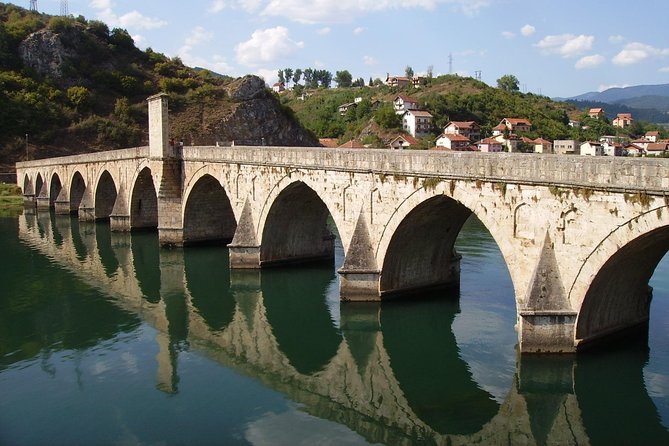
- Višegrad’s Ottoman bridge: See the Mehmed Paša Sokolović Bridge, completed in 1577 and added to the UNESCO World Heritage List in 2007.
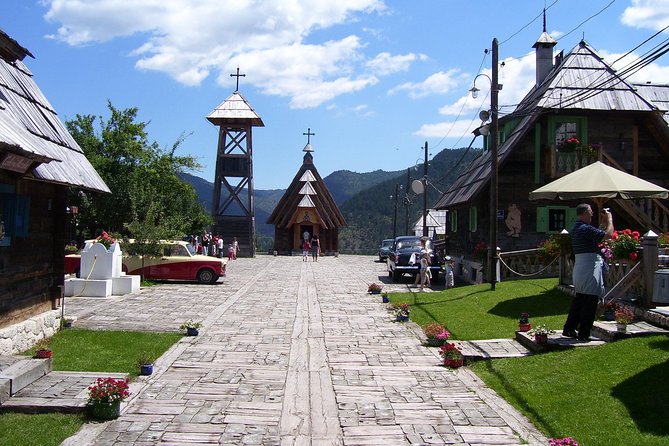
- Two very different Serbian stops: Andrićgrad is a planned stone town tied to writer Ivo Andrić, while Drvengrad is a film-set village built by director Emir Kusturica.
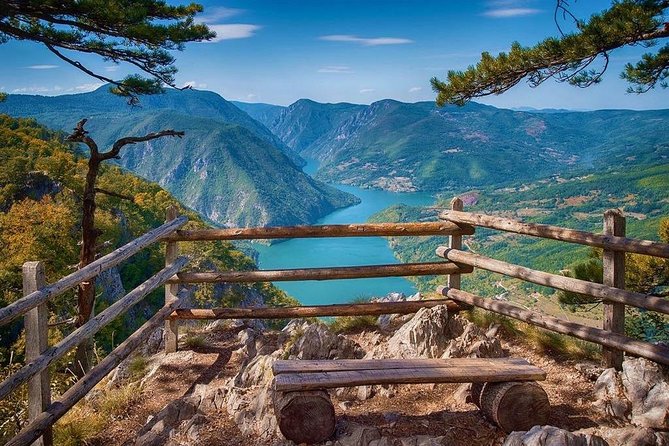
- A major Tara viewpoint: Banjska Stena looks over Lake Perućac, the Drina canyon, and the Osat area of Bosnia and Herzegovina.
- A long but useful day: The tour lasts around 12 hours, so it suits people who value sightseeing more than a quick arrival in Belgrade.
- Simple pricing: At $167.37 per person, bottled water and fees are included, but you need to arrange your own lunch.
Why this Sarajevo to Belgrade transfer works
Cross-border travel in this part of the Balkans is not only about distance. Sarajevo and Belgrade are linked by roads that pass through mountain country, small towns, the Drina River region, and places shaped by Ottoman, Yugoslav, and modern Serbian culture. This tour uses that route as a sightseeing day.
You begin at 8:00 am in Sarajevo. Pickup can be arranged at a hotel or apartment, which is useful if you have luggage and do not want to make your way to an agency office. The service is offered in English, and the maximum group size is 15. That is not a private tour, but it is small enough to feel more manageable than a large coach outing.
The route includes Rogatica, a small town in eastern Bosnia, before reaching Višegrad. From there, it continues into Serbia for Drvengrad, Banjska Stena, and Mokra Gora. The order and exact timing can depend on road conditions and border formalities, so you should think of the schedule as a full-day framework rather than a minute-by-minute plan.
I would choose this trip when the transfer itself is unavoidable and you have enough time for a long day. If you simply need to reach Belgrade as quickly as possible, a direct connection will be less tiring.
A few more Sarajevo days to weigh up
- From Sarajevo: Full-Day Hike to Lukomir Village
★ 5.0 · 59 reviews - Sarajevo Full Day Tour: History, Culture, Nature, War & Olympics
★ 5.0 · 27 reviews - Private Full Day Safari Tour
★ 5.0 · 8 reviews
Rogatica and the approach to Višegrad
Rogatica is a small town in eastern Bosnia and serves more as a route-side look at the region than as a major sightseeing stop. It gives you a sense of the smaller communities between Sarajevo and Višegrad, where the trip moves away from the capital and into the Drina area.
The appeal here is not a long list of monuments. It is the change in scale. You are leaving Sarajevo behind and entering a quieter part of Bosnia. The road journey is part of the experience, so use this early stretch to settle in, ask the guide questions, and keep some energy for the major stops later.
The itinerary allows short visits rather than long walks at several locations. That helps the tour cover a lot of ground, but it also means you should not expect an extended exploration of every town. Comfortable shoes remain useful, since the day includes bridge approaches, town streets, and viewpoint paths.
Višegrad and the Drina River
Višegrad is the historical heart of the Bosnian portion of the tour. The town sits where the Drina and Rzav Rivers meet, and its population is relatively small. The main reason to stop is the Mehmed Paša Sokolović Bridge, but the setting around the rivers gives the visit extra meaning.
You have about 20 minutes in Višegrad before visiting the nearby sites. That is enough to get your bearings and take in the town, but it is not enough for a slow, detailed walk through every corner. Keep your camera ready and listen closely as the guide explains the town’s place in the region.
The bridge became widely known through Ivo Andrić’s novel The Bridge on the Drina. Even if you have not read the book, the connection helps explain why this crossing matters beyond its attractive stone arches. It is a piece of Ottoman-era engineering that still defines Višegrad’s identity.
The Mehmed Paša Sokolović Bridge
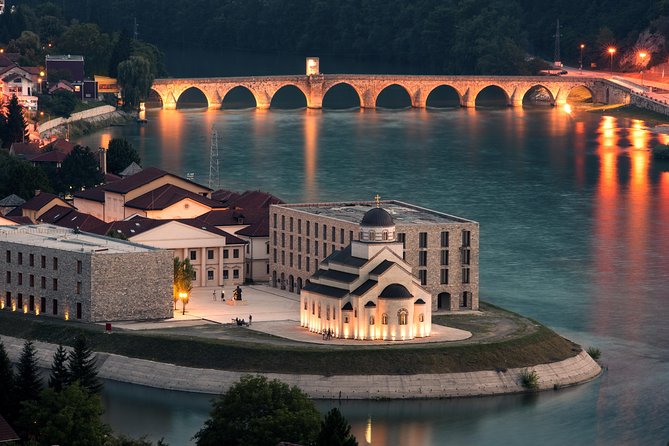
The bridge is the strongest single stop on the Bosnia side. Built in 1577 by Ottoman court architect Mimar Sinan on the order of Grand Vizier Mehmed Paša Sokolović, it crosses the Drina with a series of stone arches. UNESCO added it to the World Heritage List in 2007.
You have around 20 minutes here, with admission included. That is a short visit, but the bridge is easy to appreciate without a museum-length stop. Walk across if conditions and timing allow, pause to look along the river, and notice how the structure connects the town with the water below.
I like this part of the route because it gives the day a clear historical anchor. The bridge is not a modern reconstruction made for tourists. It is an old working crossing with a direct connection to the Ottoman period and to one of the best-known novels from the former Yugoslavia.
The limitation is time. A 20-minute stop allows photographs and a quick look, not a full reading of the monument’s history. If the bridge is your main reason for booking, keep your expectations realistic and make the most of the guide’s explanation.
A completely different kind of day out of Sarajevo:
- Sarajevo: Mostar, Konjic, Blagaj Tekke, Pocitelj & Waterfall
★ 4.9 · 1,335 reviews - Fall of Yugoslavia, Sarajevo War Tour with Tunnel of Hope Museum and Frontlines
★ 5.0 · 1,314 reviews - Sarajevo: Mostar, Konjic, Sufi House, Pocitelj & Kravice Falls
★ 5.0 · 1,179 reviews - ROSES OF SARAJEVO (Official WAR + CITY tour)- Story of a Survivor
★ 5.0 · 770 reviews
Andrićgrad, a modern town built around a writer
Andrićgrad, also called Kamengrad or Stone Town, is only a short distance from the bridge. It was created by film director Emir Kusturica and dedicated to Ivo Andrić. Construction began in 2011, and the town officially opened in 2014.
The project is an unusual place. It is not an old medieval quarter that survived unchanged. It is a modern construction designed to evoke different periods and styles connected with Andrić and the wider Balkan past. That makes it visually interesting, but you should see it as a cultural and architectural project rather than an untouched historic town.
The visit lasts about 20 minutes, and admission is included. That timing suits a quick walk and photographs. You can notice the stone buildings, public spaces, and details that give the place its theatrical quality. The guide’s commentary is especially useful here because Andrićgrad can feel puzzling if you do not know why it was built.
I would pair this stop mentally with the bridge. Višegrad gives you the genuine Ottoman monument, while Andrićgrad offers a modern interpretation of regional history and literature. Together, they show two different ways the Drina area presents its past.
Crossing into Serbia and reaching Drvengrad
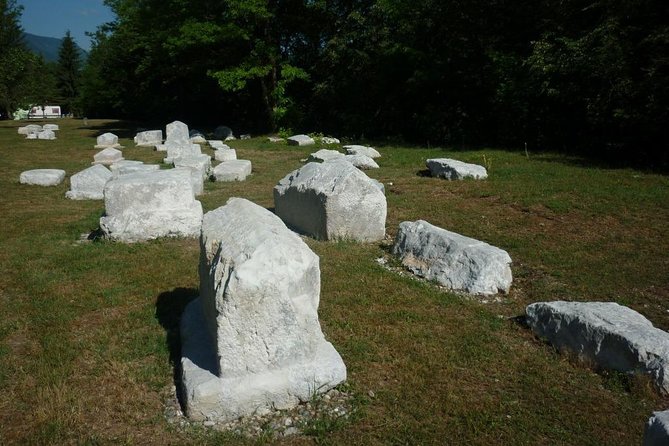
The route then continues into Serbia toward Drvengrad, also known as Mećavnik. You have about an hour here, making it one of the longer stops. This is a good place to stretch your legs after the morning drive.
Drvengrad was built by Emir Kusturica during work connected with the film Life Is a Miracle. It began as a personal home and grew into a small wooden village with cultural and hospitality spaces. Its design drew inspiration from older towns, including Ephesus, and it was intended to create a compact community rather than another spread-out modern development.
You will find timber buildings, lanes, and a strong film-world atmosphere. The village is designed, not accidental, so it can feel more like a carefully made setting than an ordinary Serbian settlement. That is part of its appeal. You are seeing a place shaped by cinema, architecture, and Kusturica’s ideas about community.
The description of Mećavnik also emphasizes organic food production, with a juicery, a barn, vegetables from nearby Barakovac, and livestock. The site includes a ski resort on Mount Tara, although the tour’s one-hour stop may not allow time to see every part of the wider area.
I like Drvengrad for the change of mood. After the bridge and Andrićgrad, both tied to Višegrad and Andrić, this stop shifts toward film and contemporary cultural identity. If you prefer old monuments only, it may feel less essential. If you enjoy unusual places with a story behind their construction, it earns its place on the route.
Banjska Stena and the view over Lake Perućac
Banjska Stena is the scenic high point of the day. The viewpoint is about 10 kilometers from Mitrovac and has a marked road, benches, and a safety fence. The tour allows around one hour, including the journey to the viewpoint and time to look out.
From the top, you can see Lake Perućac, the Drina canyon, and the Osat area in Bosnia and Herzegovina. Lake Perućac is an artificial lake created in 1966 by damming the Drina for the Bajina Bašta hydroelectric plant. It extends for about 52 kilometers and is now used for boating, swimming, and fishing.
The view changes the pace of the day. The earlier stops ask you to look at buildings and cultural sites. Here, you are looking across water, cliffs, forested slopes, and the winding course of the Drina. The benches and fence make it easier to pause without turning the stop into a strenuous hike.
The name Banjska Stena comes from Banjsko vrelo, a spring below the viewpoint. The spring once had water that stayed warm in winter, despite its cold source temperature, but it was later flooded when Lake Perućac was created. Below the viewpoint is Banjsko točilo, a scree slope once used to move timber toward the Drina.
This is the stop most dependent on clear conditions. The tour includes the viewpoint, but no one can guarantee perfect visibility. Even with haze, the location adds welcome fresh air and space to a long road day. Bring a light layer and sensible footwear, since this is a mountain viewpoint rather than a city pavement stop.
Mokra Gora and the Šargan Eight
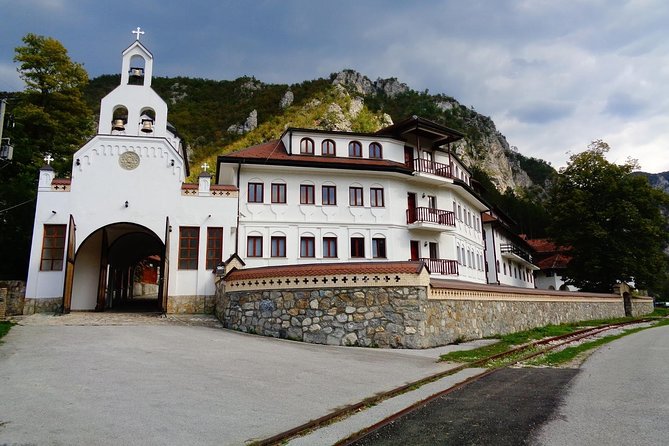
Mokra Gora brings the day back to one of Serbia’s best-known cultural and railway areas. The region is associated with the Šargan Eight, a narrow-gauge heritage railway running between Mokra Gora and Šargan Vitasi.
The railway’s name comes from its unusual route, which forms a shape like the number eight as it climbs through the hills. An extension toward Višegrad in Republika Srpska was completed in 2010. The tour allows about two hours in Mokra Gora, but the provided schedule does not state that a train ride is included.
That point matters. You should treat Mokra Gora as a visit to the railway area and surrounding site, not assume that your package includes a scheduled train journey. The admission details list this stop as included, while lunch is specifically excluded. If riding the railway is important to you, confirm the plan with the provider before booking.
Mokra Gora works well near the end of the day because it gives you another distinct setting. You have moved from Ottoman architecture to literary architecture, then to a film village, a mountain viewpoint, and finally a heritage railway area. The variety is the main strength of this route.
What $167.37 buys you
At $167.37 per person, this is not a cheap transfer. It is also not priced like a simple taxi ride, because you are paying for a full day of transport, an English-speaking guide, several stops, bottled water, and included fees.
The value depends on your plans. If you were already going from Sarajevo to Belgrade and would otherwise spend the day on a direct journey, the added cost buys you access to Višegrad, Drvengrad, Banjska Stena, and Mokra Gora. It also removes the need to arrange separate transport between several sites.
The price is easier to justify for solo visitors and couples who want structure. A group discount may improve the value for larger parties, and the maximum group size of 15 keeps the experience from becoming a large coach excursion. Lunch is not included, so plan for that extra expense and ask the guide how the day’s meal timing will work.
The included entrance fees are helpful because you do not need to keep calculating small charges at each stop. Bottled water is also provided, which is a modest but practical touch on a long day.
Timing, comfort, and the guide
The day starts at 8:00 am and lasts about 12 hours. That means you should expect a full day in a vehicle, broken up by short walks and several sightseeing stops. The route crosses from Bosnia and Herzegovina into Serbia, so border timing can affect the schedule.
The guide and driver matter a great deal here. The strongest praise focuses on kindness, competence, clear explanations, interesting facts, and a feeling of safety during the drive. No guide name is provided, so you should not expect to request a particular person based on the available details.
A group of up to 15 is a useful middle ground. You get more company than on a private tour, but the group is small enough for the guide to communicate without a microphone and for pickup arrangements to remain manageable. The service also allows service animals, and most people can participate.
I would start the day rested and avoid booking an evening activity in Belgrade that cannot be changed. The tour is built around a long transfer, not a relaxed half-day outing. Its pace is rewarding, but you need to accept that several stops will be brief.
Who should book this trip
This tour suits you if you want to connect Sarajevo and Belgrade while seeing parts of Bosnia and Serbia that are awkward to reach independently. It is especially useful for people interested in Ottoman monuments, Ivo Andrić, Yugoslav film culture, mountain views, and historic railways.
It also works well if you prefer a guided road day to managing border transport and several separate tickets. The route is varied enough to keep the day interesting, and the guide’s explanations add context at places that might otherwise look disconnected.
I would hesitate if you dislike long drives, need a slow pace, or want extended time at one major attraction. You should also think twice if your main goal is simply to arrive in Belgrade early. This is a sightseeing transfer, not an express shuttle.
Cancellation is flexible if your plans change: you can receive a full refund when you cancel at least 24 hours before the start time. The experience requires a minimum number of participants, so a cancellation by the operator may lead to another date or a full refund.
Should you book the Sarajevo to Belgrade tour?
Book it if you want your transfer to become one of the main sightseeing days of your Bosnia and Serbia trip. The Mehmed Paša Sokolović Bridge, Andrićgrad, Drvengrad, Banjska Stena, and Mokra Gora offer a strong mix of history, art, film, and scenery.
Skip it if 12 hours on the road sounds exhausting or if you need a guaranteed fast arrival. For the right person, $167.37 is a fair price for a guided cross-border day with transport and entry fees included. Just start early, plan for lunch, confirm the Mokra Gora arrangements, and leave your evening flexible.
FAQ
How long does the Sarajevo to Belgrade tour take?
The tour lasts approximately 12 hours.
What time does the tour start?
The stated start time is 8:00 am.
Where can pickup take place?
Pickup can be arranged at the address of a hotel or apartment in Sarajevo.
Is the tour offered in English?
Yes. The tour is offered in English.
What places are visited?
The route includes Rogatica, Višegrad, Andrićgrad, the Mehmed Paša Sokolović Bridge, Drvengrad, Banjska Stena, and Mokra Gora.
Is lunch included?
No. Lunch is not included in the price.
What is included in the tour price?
Bottled water, all fees and taxes, transportation, pickup arrangements, and the guided tour are included. The listed stops also specify included admission where applicable.
How many people can join the tour?
The maximum group size is 15 travelers.
Can I cancel for a full refund?
Yes. You can cancel at least 24 hours before the experience start time for a full refund. Changes or cancellations made less than 24 hours before the start time are not accepted for a refund.
Just added around Sarajevo
- Private Full Day Safari Tour★ 5.0 · 8 reviews
- Walking Tour in Sarajevo★ 5.0 · 3 reviews
- Sarajevo Under Siege: A War History Tour★ 5.0 · 10 reviews
- Travnik, Jajce, Pliva Lakes & Mills –Medieval & Ottoman Bosnia Full Day Tour★ 5.0 · 3 reviews
- Mysterious Visoko Pyramids Driving and Walking Tour★ 5.0 · 7 reviews
- Secret Tito’s Bunker/Konjic Tour★ 5.0 · 4 reviews
- The last day of Franz Ferdinand Walking Tour★ 5.0 · 10 reviews
- Sarajevo to/from Zagreb Transfer Day Tour (North-central Bosnia)★ 5.0 · 4 reviews
Full-Day, compared.
Mostar and Kravice Waterfalls Full-Day Tour from Split
Read our review →
Full-Day Tour in Herzegovina, Blagaj, Počitelj, and Kravice
Read our review →
Sarajevo Full Day Tour: History, Culture, Nature, War & Olympics
Read our review →
Full Day At Kravice Waterfalls in a Day Tour from Mostar
Read our review →
Browse the lists this tour appears in