
Reviewed · PRIVATE DRIVERS
Sarajevo to/from Dubrovnik Two-day Transfer Tour via Mostar
The most unusual stop comes early: Tito’s nuclear bunker, a secret underground town built beneath Konjic during the Cold War. From there, this small-group transfer winds through Herzegovina, pairing major sights with local stories, Ottoman towns, waterfalls, wine, and one useful night in Mostar.
I like two things especially. First, the route turns a necessary transfer into a proper sightseeing day, rather than losing a day to a bus or car ride. Second, the overnight in Mostar lets you see the Old Bridge after the daytime crowds have thinned. The main consideration is pace: you cover a lot in two days, and several stops involve walking or uphill ground.
Key points at a glance
- Tito’s Bunker: Spend about 90 minutes inside a vast Cold War shelter built 270 metres underground.
- Mostar overnight: Check into a four-star hotel, then take a two-hour walk through the Old Town and around the rebuilt bridge.
- Kravice Falls: Bring a swimsuit from June through September if you want to cool off in the water.
- Local Herzegovina wine: Taste four varieties, including Blatina and Žilavka, with snacks at a local cellar.
- Small-group transport: The maximum group size is eight, making the long route easier to manage.
- Door-to-door routing: Begin in Sarajevo and finish in Dubrovnik, Kotor, or Split, or take the route in reverse.
Why this transfer works better than a straight journey
At $515.63 per person, this is not a budget connection. But the price covers much more than transport. You get two days of guided touring, one night in a four-star Mostar hotel with breakfast, entrance fees to several major sights, a wine tasting, and a small group capped at eight people.
That changes the calculation. A direct transfer may get you from Sarajevo to the coast faster, but it would skip Konjic, Blagaj, Počitelj, Kravice Falls, Radimlja, and Vjetrenica Cave. You would also need to arrange a Mostar hotel and pay admission fees separately.
I would see this as a sightseeing journey with transport built in, not as a conventional guided day trip. It suits you best if you want to connect two cities while seeing a broad slice of Bosnia and Herzegovina. It suits you less if you prefer long meals, lazy afternoons, or time to explore each town at your own speed.
The maximum of eight people matters on a route with this many stops. It should make departures, photo stops, and short walks easier to handle than they would be in a large coach group. The published start time is 8:00 am, so plan for a full day from the beginning.
More private drivers working out of Sarajevo:
- Sarajevo to/from Dubrovnik Transfer Tour via Mostar & Herzegovina
★ 5.0 · 115 reviews - Sarajevo to Belgrade: Transfer With East Bosnia Tour
★ 5.0 · 63 reviews - Sarajevo to/from Belgrade UNESCO Transfer Day Tour (Fees Incl.)
★ 5.0 · 54 reviews
Konjic and the road beside the Neretva
The first stop is Konjic, an old town on the Neretva River. You get about 30 minutes to see the historic center and its distinctive six-arch bridge, which dates from the 17th century.
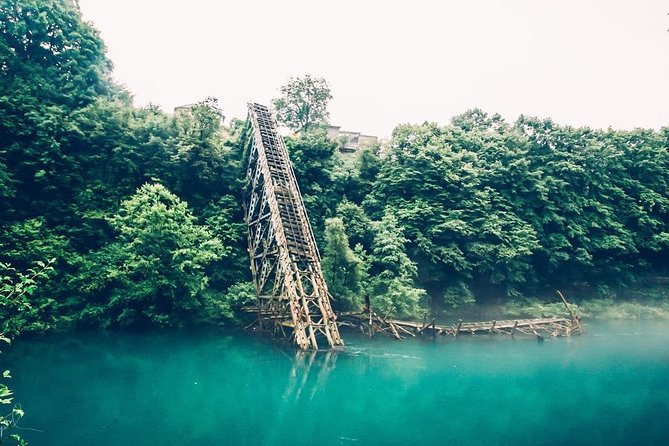
Konjic is also a good place to begin understanding the region. The guide connects the bridge, the Neretva, white-water rafting on the upper river, Boračko Lake, and the destruction of the bridge during the Second World War. The stories give the short visit more weight than a quick photo stop.
You will not have a long independent exploration period here. Think of Konjic as an introduction before the main attraction, not a complete town visit. The setting beside the turquoise river, however, makes an attractive start to the journey.
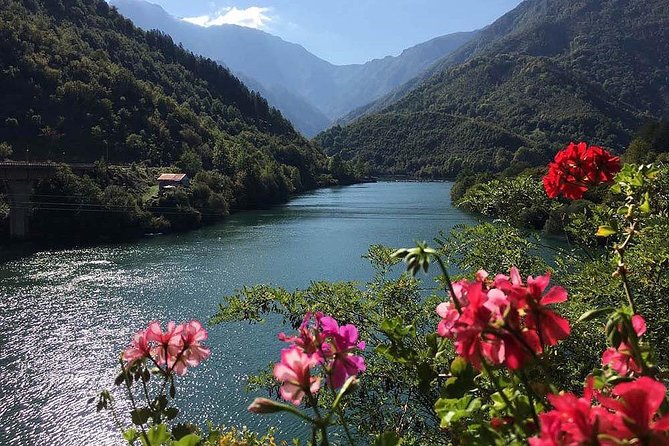
The road then follows Jablančko Lake and the Neretva canyon. A short photo stop may be made beside the lake or river, and the views toward the Prenj mountain area are a strong reason to keep your camera ready. At Jablanica, you hear about the Battle of the Neretva and the local tradition of lamb roasted on a spit.
Meals are not included, so Jablanica’s food story does not mean lunch is automatically part of the tour. You should budget separately for meals and ask your guide about the day’s food arrangements.
Inside Tito’s 270-metre-deep bunker
The visit to ARK D-0, known as Tito’s Nuclear Bunker, is the most distinctive historical stop. Construction began in the early 1950s under Josip Broz Tito, the leader of Yugoslavia, and continued for 26 years. The shelter was completed in 1979, just one year before Tito died.
Built about 270 metres underground, the bunker was designed to protect 350 people for six months after a nuclear attack. It included space for government work and living, and it reportedly cost the equivalent of nearly $4.6 billion.
You spend around 90 minutes inside. The appeal is not only the Cold War setting. The bunker shows how a government prepared for catastrophe while ordinary life continued above ground. Its scale and secrecy make it much more memorable than a standard museum room.
The entrance fee is included, listed at 10 euros per person. That is useful because the attraction is central to the first day, and you do not need to organize a separate ticket at the door.
If enclosed spaces are difficult for you, keep the underground setting in mind before booking. The supplied tour details do not describe accessibility inside the bunker, so ask the operator for more information if that is important to you.
Blagaj, the Buna spring, and Mostar after dark
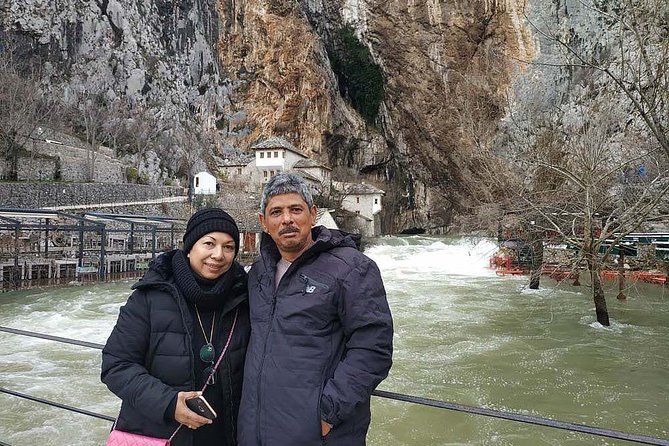
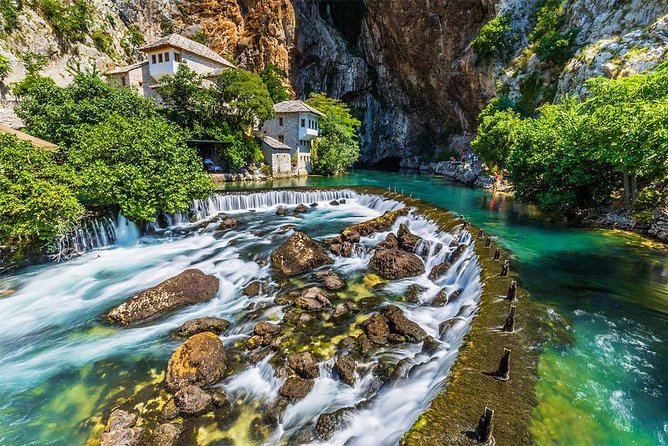
Blagaj brings a completely different mood. The Buna River rises from a large cave below a high rock face, and the water is described as exceptionally clear and powerful. The spring produces about 43 cubic metres of water per second, making it one of Herzegovina’s most striking natural sights.
Beside the spring is the Blagaj Tekke, a Dervish house associated with the early Ottoman period. The complex offers a way to learn about Dervish life and Islamic practice in Bosnia and Herzegovina. The entrance fee of 5 euros is included.
You have about two hours in Blagaj. That gives you time for the spring and the religious complex, though you should dress respectfully for a place of worship. The tour information notes that prayers take place five times a day and may be attended by Muslim visitors.
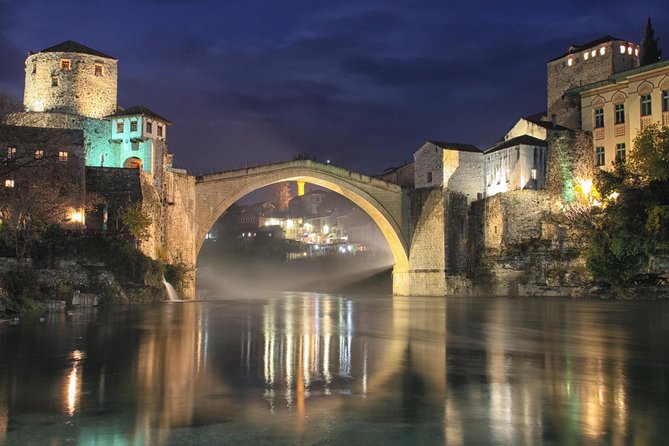
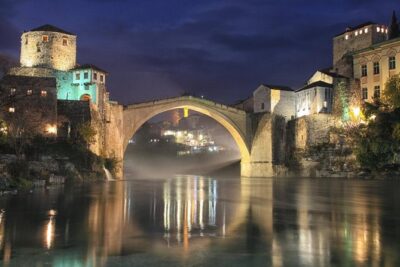
Mostar comes next. After hotel check-in, you take a guided walk of about two hours through the Old Bridge, Old Bazaar, and Old Town. The focus is not just the postcard view. You learn how the bridge was built, destroyed during the Siege of Mostar, and rebuilt.
That human story is what makes the walk worthwhile. Mostar is often reduced to one famous bridge, but the route presents the city as a meeting place of different religious and cultural traditions. The name Mostar is also explained through local history and identity.
You spend the night at Hotel Eden or a similar four-star property, sharing a twin or double room. Breakfast is included. Dinner is not, so you can choose a meal independently or arrange to eat with the group if that option is offered by the guide.
The overnight is one of the strongest features. Mostar can feel crowded during the main daytime hours, while the evening gives you a calmer chance to look around. You still have only one night, so do not expect a long, unplanned stay, but it is far better than seeing the city only through a vehicle window.
A few more Sarajevo days to weigh up
- Sarajevo: Mostar, Konjic, Blagaj Tekke, Pocitelj & Waterfall
★ 4.9 · 1,335 reviews - Fall of Yugoslavia, Sarajevo War Tour with Tunnel of Hope Museum and Frontlines
★ 5.0 · 1,314 reviews - Sarajevo: Mostar, Konjic, Sufi House, Pocitelj & Kravice Falls
★ 5.0 · 1,179 reviews - ROSES OF SARAJEVO (Official WAR + CITY tour)- Story of a Survivor
★ 5.0 · 770 reviews
Počitelj and the climb through an Ottoman town
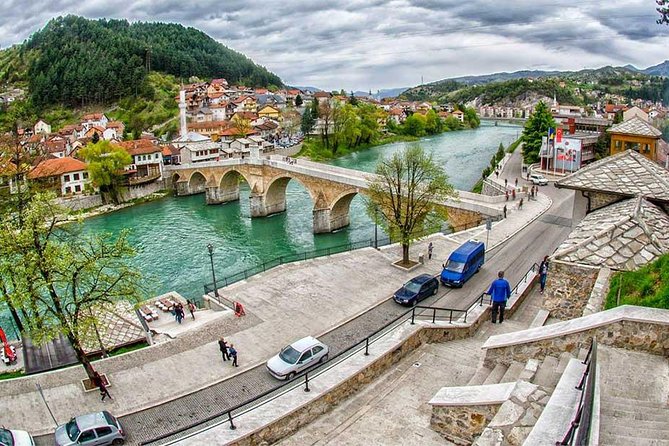
Day two begins with Počitelj, a remarkably preserved historic town above the Neretva. The walking route takes about an hour and includes some uphill ground.
You visit important sites such as the Hajji Alija Mosque, the Clock Tower, and the Gavrankapetanović Tower. The guide explains Počitelj’s strategic role over more than 600 years and the way its medieval and Ottoman forms have survived.
This is an active stop, not a flat stroll. Wear shoes that are comfortable for uneven or uphill walking, and take the climb at your own pace. The reward is the town’s unusual shape, with stone buildings and fortifications arranged above the river.
The visit is relatively short, so you will see the main points rather than explore every corner. That is a fair trade on a route already packed with major stops, but anyone wanting a slow architectural study may wish for more time.
Kravice Falls, Herzegovina’s best nature stop
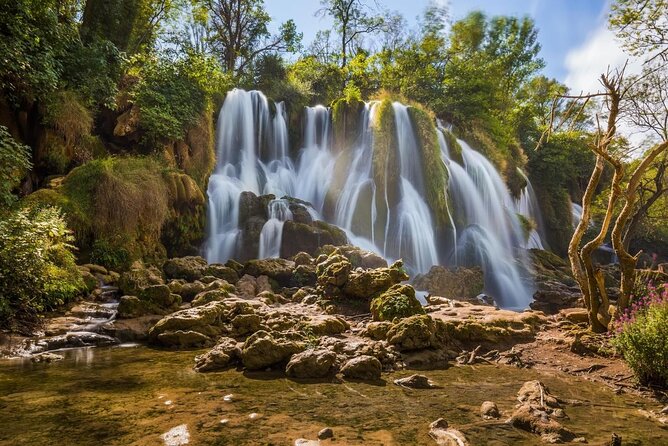
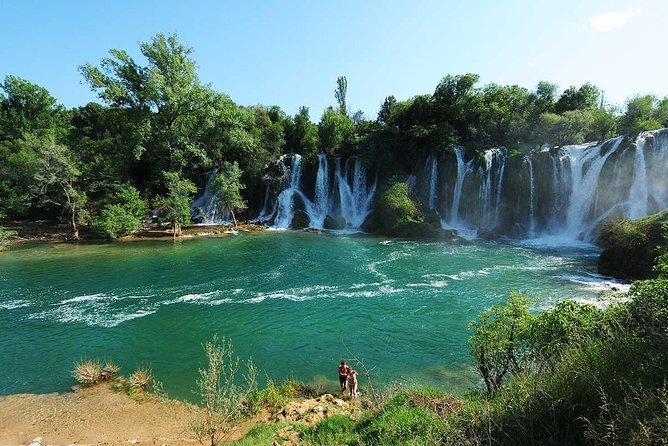
Kravice Falls is the natural highlight of the second day. The Trebižat River drops over travertine formations in a broad amphitheater, with falls reaching roughly 26 to 28 metres and a basin about 120 metres across.
You get about an hour here, and the entrance fee is included. From June through September, bring a swimsuit if you want to swim, or simply cool your feet near the water. Even without swimming, the setting gives the busy schedule a welcome change of pace.
The one-hour stop is enough for photographs and a short break, but not for a leisurely day beside the falls. If swimming is important to you, confirm how much free time the group will have and be ready to change quickly.
Kravice also shows why the transfer format has value. This is not a minor roadside viewpoint. It is a major natural attraction that would require separate planning if you were moving between Sarajevo and the coast on your own.
Herzegovina wine and the choice of lunch
West Herzegovina has a long winemaking tradition, and the stop at a local cellar gives the route a regional taste. You sample four local wines and snacks, including Blatina, a red wine, and Žilavka, a white wine.
The visit also introduces biodynamic winemaking and the direction of modern wine production in Herzegovina. For you, the point is not simply to drink. It is a chance to connect the dry western part of the country with its agricultural traditions.
The wine tasting is included. If you do not drink wine, an alternative local lunch can be arranged according to the tour details. Since meals are generally excluded, this is worth clarifying before the trip so you know what food option will be available.
Because the day includes driving, several walks, and more sightseeing afterward, pace yourself at the tasting. The stop is designed as a cultural experience, not a long winery afternoon.
Medjugorje, Radimlja, and the final cave
Medjugorje is a brief stop of about 45 minutes. Since 1981, the town has drawn Catholic pilgrims connected with reported apparitions of the Virgin Mary. The visit gives you a short look at one of southeastern Europe’s best-known pilgrimage places.
You should keep your expectations realistic. Forty-five minutes allows for orientation and a quick visit, not a full religious pilgrimage or extended reflection. If Medjugorje is the main reason you want to visit Herzegovina, this tour does not provide enough time for a detailed experience.
Radimlja, near Stolac, offers a different kind of mystery. The site contains medieval stećci, carved tombstones that began appearing in the mid-12th century and reached their height in the 14th and 15th centuries. Their origin and symbols remain subjects of discussion.
The stop lasts about 15 minutes, and the 3-euro entrance fee is included. That is enough to see the necropolis and hear its basic story, but it is clearly a compact stop rather than a full archaeological visit.
The final attraction is Vjetrenica Cave, one of the world’s most biodiverse caves. You have about an hour inside, with the admission fee included at 10 euros per person. After two days of open views, waterfalls, and historic towns, the cave provides a fitting change of setting before the journey reaches its end.
What the price includes, and what it does not
The $515.63 price includes several costs that can add up quickly:
- One night in a four-star Mostar hotel
- Breakfast
- Tito’s Bunker admission
- Blagaj Tekke admission
- Bosnaseum Museum admission
- Kravice Falls admission
- Four-wine tasting with snacks
- Radimlja Necropolis admission
- Vjetrenica Cave admission
Meals are not included. This is the main extra expense to plan for, along with any personal purchases. The tour also offers group discounts, though the available discount is not specified.
The value is strongest if you were already planning to travel from Sarajevo to the Adriatic coast and would otherwise pay for transport, a hotel, and separate admission tickets. It is weaker if you already have accommodation in Mostar or want to spend most of your time in just one or two places.
The route can begin in Sarajevo and finish in Dubrovnik, Kotor, or Split. It can also run in the opposite direction, and the full sightseeing program remains the same. That flexibility is useful when arranging a wider Bosnia and Croatia, Montenegro, or Dalmatia itinerary.
Who should book this two-day route
I would recommend it to you if you want a broad first look at Herzegovina and prefer a guide to handle the route between cities. It is especially good for couples, families, and small groups who value historical explanation, included admissions, and a night in Mostar.
The tour also works well for people who dislike changing hotels every night. You unpack once in Mostar, see the city with a local guide, and continue the next day.
I would hesitate if you want a relaxed holiday rhythm. The route includes many stops, an early start, a long first day, uphill walking in Počitelj, and several short visits. It is also not the best choice if your main interest is only Mostar, Medjugorje, or the waterfalls.
A guide such as Enis can make a real difference on a route packed with stories. The tour information highlights his warm personality and strong grasp of the sights, which matters when the experience depends on connecting places such as Konjic, Mostar, and the Neretva with the larger story of Bosnia and Herzegovina.
Should you book it?
Book this tour if you want the most sightseeing from a two-day transfer between Sarajevo and the coast. The mix is unusually strong: a Cold War bunker, Ottoman architecture, a rebuilt bridge, a mountain river, a waterfall, local wine, medieval tombstones, and a major cave.
Skip it if you want long free periods, independent exploration, or a low-cost point-to-point ride. For the right kind of visitor, the price pays for both transport and a well-filled introduction to Herzegovina, with the overnight in Mostar making the schedule feel more worthwhile.
FAQ
Where does the tour start?
The tour starts in Sarajevo at 8:00 am. It can also operate in the opposite direction.
Where can the tour finish?
The journey can finish in Dubrovnik, Kotor, or Split, depending on the selected route.
How many people can join the tour?
The maximum group size is eight travelers.
Is hotel accommodation included?
Yes. One night in a four-star hotel in Mostar is included, in a twin or double room shared with another person. Hotel Eden or a similar property is used.
Is breakfast included?
Yes. Breakfast at the Mostar hotel is included.
Are meals included?
No. Meals are not included, although a local lunch may be arranged as an alternative to the wine tasting for people who do not want to taste wine.
Is Tito’s Bunker admission included?
Yes. The entrance fee to Tito’s Bunker, listed as 10 euros per person, is included.
Is the wine tasting included?
Yes. The tasting includes four local wines and snacks.
Can you swim at Kravice Falls?
Swimming is possible during the summer period from June through September. You should bring a swimsuit if you want to swim or cool your feet.
Can you cancel for a full refund?
Yes, if you cancel at least 24 hours before the experience start time. Cancellations made less than 24 hours in advance are not refundable.
Just added around Sarajevo
- Private Full Day Safari Tour★ 5.0 · 8 reviews
- Walking Tour in Sarajevo★ 5.0 · 3 reviews
- Sarajevo Under Siege: A War History Tour★ 5.0 · 10 reviews
- Mysterious Visoko Pyramids Driving and Walking Tour★ 5.0 · 7 reviews
- Secret Tito’s Bunker/Konjic Tour★ 5.0 · 4 reviews
- Travnik, Jajce, Pliva Lakes & Mills –Medieval & Ottoman Bosnia Full Day Tour★ 5.0 · 3 reviews
- The last day of Franz Ferdinand Walking Tour★ 5.0 · 10 reviews
- Sarajevo to/from Zagreb Transfer Day Tour (North-central Bosnia)★ 5.0 · 4 reviews
Private Drivers, compared.
Sarajevo to/from Dubrovnik Transfer Tour via Mostar & Herzegovina
Read our review →
Sarajevo to Belgrade: Transfer With East Bosnia Tour
Read our review →
Sarajevo to/from Belgrade UNESCO Transfer Day Tour (Fees Incl.)
Read our review →
Sarajevo to Split (or opposite): Transfer With Herzegovina Tour
Read our review →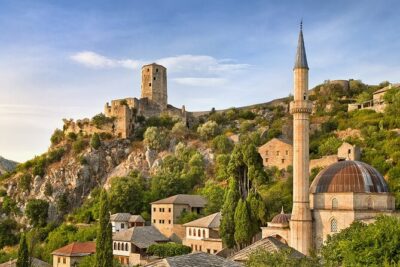
Transfer Mostar to Dubrovnik with Kravice Waterfalls, Blagaj and Počitelj tour
Read our review →
Sarajevo to Dubrovnik: Transfer With Herzegovina Tour
Read our review →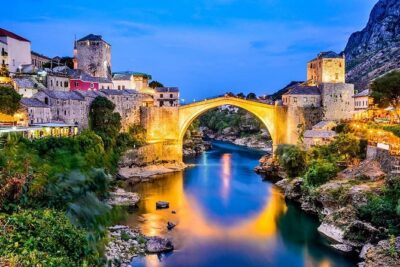
Transfer from Sarajevo to Kotor+Herzegovina tour
Read our review →
Sarajevo to/from Zagreb Transfer Day Tour (North-central Bosnia)
Read our review →Browse the lists this tour appears in