
Reviewed · WALKING TOURS IN SARAJEVO
PROFESSIONAL SARAJEVO WALKING TOUR – With guide who guided STING!
Sarajevo’s past is packed into a remarkably walkable center, and this evening tour moves from Catholic cathedral to Orthodox church, Ottoman bazaar, Jewish quarter, and the bridge linked to the start of World War I. The guide is Mak, also presented as the guide who once guided Sting, so you get a local host with an unusual story of his own.
I like the small-group format, which keeps the $31.24 price sensible while giving you a better chance to ask questions. I also like the mix of famous sights and small details, from Sarajevo Roses and copperware streets to the spot where Franz Ferdinand was assassinated. The main caution is pace: twelve stops in two to three hours means short visits rather than long time inside buildings.
Key points before you book
- Mak leads a compact Sarajevo overview: The tour is in English and is designed to cover the city center in one evening.
- The route crosses several faiths and eras: You see the Catholic cathedral, Serbian Orthodox church, Gazi Husrev-Beg Mosque, and Sephardi synagogue area.
- War history is part of the walk: Sarajevo Roses, Markale Market, the Eternal Flame, and other sites connect the city’s recent past with World War I and World War II.
- The group size is intended to stay small: The tour description mentions a maximum of 15, while the additional information states a maximum of 10. Confirm the current limit when booking.
- The price includes a lot of ground: At $31.24 per person, you get a guided orientation to the main center without paying separate admission fees at the listed stops.
- The 6:15 pm start changes the feel: You walk in the cooler part of the day, but daylight can affect the views and photographs as the tour progresses.
Why this Sarajevo walk works as a first look
I would use this tour early in a Sarajevo visit. It gives you a map in your head, introduces the city’s layered past, and points out places you can revisit later at your own pace.
The route is not just a parade of grand buildings. Sarajevo’s identity comes from its close quarters. A cathedral, Orthodox church, mosque, synagogue, market, fortress, and memorial can all appear within one extended walk. That makes the tour useful for understanding how the city’s religious and political stories overlap.
The evening start at 6:15 pm is practical in warm weather. You avoid the strongest afternoon heat and get a different mood around the pedestrian streets and squares. On the other hand, the later start means some stops may feel brief, especially if the walk runs closer to two hours or daylight fades before the final viewpoints.
The experience is offered in English and costs $31.24 per person. Since the listed stops are free, the value comes from the guide’s explanations, route planning, and ability to connect scattered places into one story. That is a fair price for an introductory city walk, especially if you are in Sarajevo for a short stay.
More Walking Tours in Sarajevo
- Sarajevo: 2 Hours Old Town Walking Tour With Local Guide
★ 5.0 · 505 reviews - Private Walking Tour, Food Tasting and Bosnian Coffee in Sarajevo
★ 5.0 · 255 reviews - Sarajevo Grand Walking Tour
★ 5.0 · 232 reviews
From the Sacred Heart Cathedral to Sarajevo’s Roses
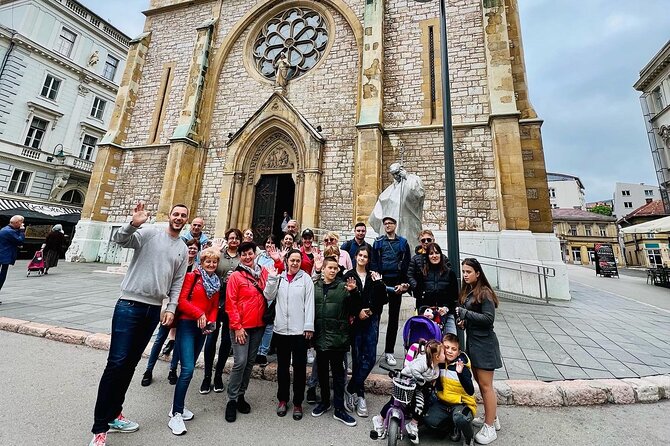
The first stop is the Sacred Heart of Jesus Cathedral, locally called Katedrala Srca Isusova. Its presence gives you an immediate sense of Sarajevo’s religious mix. The walk also introduces the Sarajevo Roses, red marks in the pavement made to remember places where mortar explosions caused deaths during the siege.
You should expect about 15 minutes here. That is enough for an explanation and a look around, but not a detailed cathedral visit. If you want to study the interior or architecture at length, return on your own.
Sarajevo Roses are especially useful for understanding how the city’s war memory appears in ordinary streets. They are not set behind glass in a museum. They are part of the pavement, encountered while people go about daily life. Mak’s explanations help make those marks easier to read without turning the stop into a long lecture.
Orthodox heritage and the Mondo sculpture
The route continues to the Serbian Orthodox Church of the Nativity of the Theotokos. This is another important piece of Sarajevo’s religious mix, and it follows naturally after the Catholic cathedral.
The stop also includes the Mondo sculpture and a city park. The planned time is about 15 minutes, so you will likely hear the setting explained from outside or during a short pause rather than spend a long time inside the church.
This part of the walk is a good reminder that Sarajevo cannot be reduced to one culture or one period. The close sequence of religious buildings gives the city center a layered feel, and the park offers a brief change from the paved streets.
Ferhadija, Tito Street, and the Eternal Flame
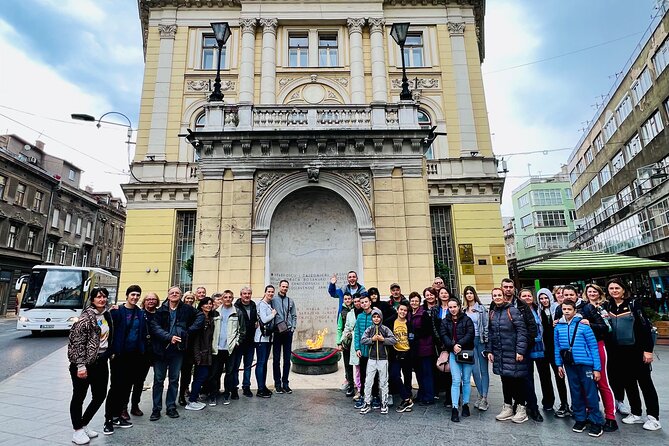
Ferhadija Pedestrian Street brings you into one of the city’s main walking areas. Here the tour includes the Eternal Flame, Tito Street, and the first Sarajevo Rose.
The Eternal Flame commemorates Sarajevo’s liberation from fascism in World War II. It is a small but meaningful stop, and the tour returns to it near the end as well. Seeing it early in the route and again as a formal final stop may feel repetitive, but the second visit gives the guide a chance to tie the city’s World War II story into the broader route.
The first Sarajevo Rose adds a more recent layer. Together, these memorials show how Sarajevo remembers different conflicts in public spaces. The planned time here is 15 minutes, so listen closely and take your photographs before the group moves on.
A completely different kind of day out of Sarajevo:
- Sarajevo: Mostar, Konjic, Blagaj Tekke, Pocitelj & Waterfall
★ 4.9 · 1,335 reviews - Fall of Yugoslavia, Sarajevo War Tour with Tunnel of Hope Museum and Frontlines
★ 5.0 · 1,314 reviews - Sarajevo: Mostar, Konjic, Sufi House, Pocitelj & Kravice Falls
★ 5.0 · 1,179 reviews - ROSES OF SARAJEVO (Official WAR + CITY tour)- Story of a Survivor
★ 5.0 · 770 reviews
Gazi Husrev-Beg Mosque and the Ottoman quarter
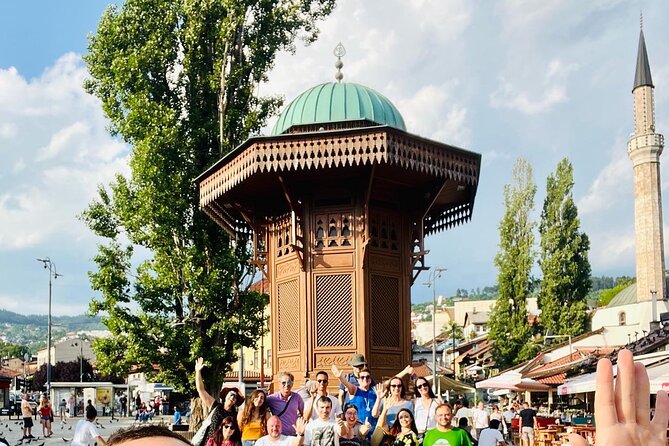
The tour then reaches Gazi Husrev-Beg Medresa, Gazi Husrev-Beg Mosque, Bezistan Bazaar, the Clock Tower, and Jewel Street. This is one of the strongest sections for getting a feel for old Sarajevo.
The mosque is tied to the city’s Ottoman period, while the bazaar and narrow commercial streets show how trade shaped the center. Bezistan Bazaar is a covered market, and Jewel Street adds another small-scale shopping lane to the route. The Clock Tower helps anchor you in the old quarter.
Allow about 20 minutes. That is the longest scheduled stop, which makes sense because several sights are grouped together. You should not expect a full guided visit to every interior. Instead, you get a compact orientation and can mark the places that deserve a return visit.
Dress smart casual. The tour includes religious sites, so modest clothing is the sensible choice even though no strict clothing rules are listed. If you want to enter a mosque later, ask Mak about the appropriate procedure and timing.
Latin Bridge and the assassination that changed Europe
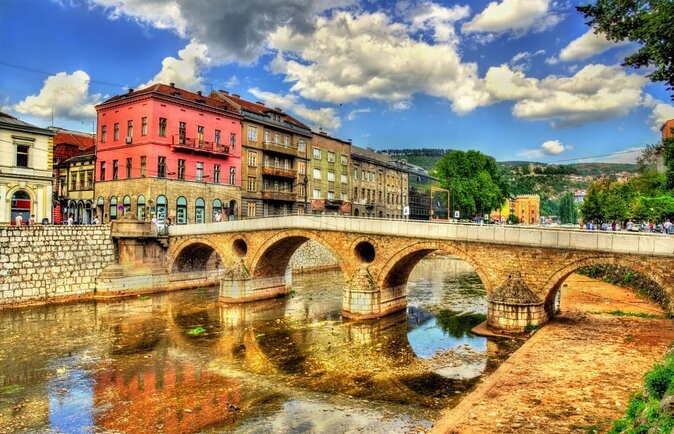
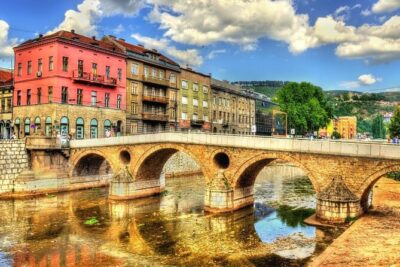
The walk reaches the Mausoleum of Princip Gavrilo and Latin Bridge, including the assassination spot linked to Archduke Franz Ferdinand and his wife Sophie. The Latin Bridge is one of Sarajevo’s most famous landmarks because the 1914 killing helped trigger World War I.
The route lists this area twice, once around the mausoleum and again as a separate Latin Bridge stop. That may mean you encounter the bridge from more than one angle or receive the story in two stages. Either way, this is a place where the physical setting matters. The event did not happen at a distant battlefield. It happened beside an ordinary city street and bridge.
You get about 15 minutes at the first pass and another 15 minutes at the later Latin Bridge stop. The repeated focus may suit anyone who wants historical context, but it can feel like overlap if you prefer a faster walk. This is one of the best places to ask Mak how Sarajevo’s local story fits into the larger European crisis.
City Hall, Inat Kuca, and the view toward the fortresses
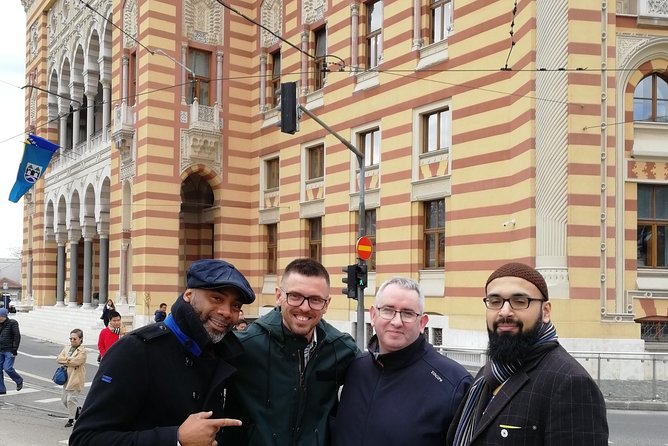
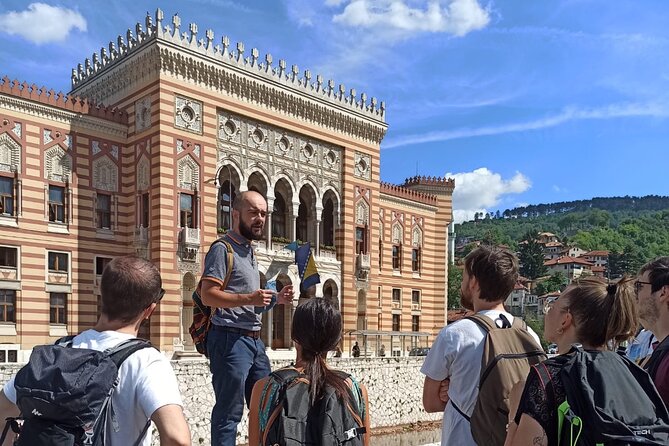
Sarajevo City Hall is one of the route’s visual highlights. The stop also points out Inat Kuca, the White Fortress, Yellow Fortress, Jajce Army House, and the 1984 Olympic mountain.
The planned time is 20 minutes, but this is a lot to cover. City Hall and Inat Kuca are nearby urban sights, while the fortresses and Olympic mountain are best understood as points in the wider city view. You may see some from a distance rather than walk to each one.
This is where the tour’s broad scope becomes clear. You are getting a city orientation, not a series of full site visits. The guide can tell you what each place is and how it fits into Sarajevo, then you can decide where to spend more time during the rest of your stay.
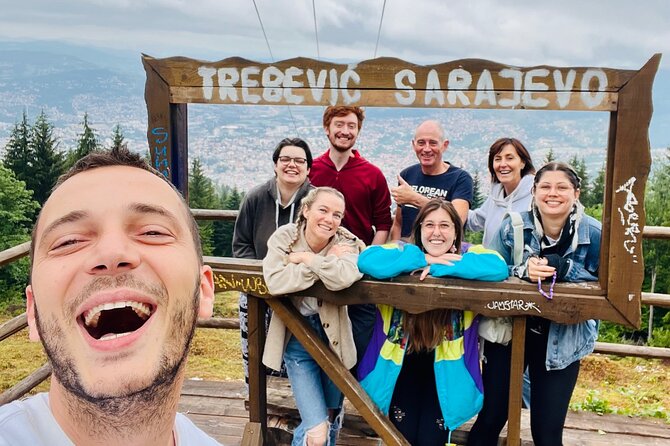
If you care about photographs, keep your phone ready. The tour begins at 6:15 pm, and light can change quickly during the walk. The information provided does not promise a sunset stop or a long viewpoint visit, so treat the fortresses and Olympic mountain as part of the city overview rather than a dedicated lookout excursion.
Yellow Fortress, Kovaci Street, and local food lanes
The Yellow Fortress section includes Kovaci Street and a food street, with about 15 minutes set aside. The fortress is one of the better-known elevated points around the old city, while Kovaci adds a more residential and memorial side to the route.
The food street gives you a chance to note places for a later meal or snack. Since the tour is walking-focused and no food is included, plan to eat before or after rather than count on tasting stops.
This section may be especially useful if you want to get beyond the most photographed center. It connects the historic core with streets that feel more local in scale. Wear comfortable shoes, since a route that includes fortresses and old streets can be less even than a flat pedestrian boulevard.
Sebilj, Kazandziluk, and pigeon square
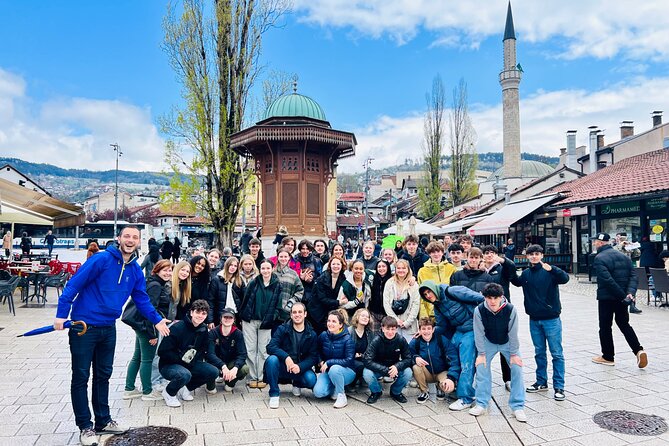
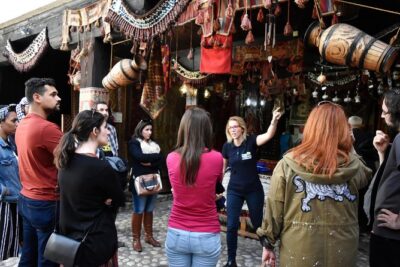
The Sebilj fountain is one of Sarajevo’s best-known meeting points. It sits in the old bazaar area near Kazandziluk Street, traditionally associated with copperware, and Pigeon Square.
The scheduled time is 15 minutes. That is enough to see the fountain, hear why the square matters, and take in the surrounding shops. It is also a natural place to get your bearings because several streets radiate from the square.
Kazandziluk is a useful detail in the route because it shows the working side of the old quarter. You are not only looking at monuments. You are also seeing the kinds of streets where crafts and small trade remain part of the city’s identity.
Markale Market and the Sarajevo Roses
Pijaca Markale, or Markale Market, brings the tour back to Sarajevo’s wartime memory. The stop includes the Yellow Market, the largest Sarajevo Rose, and a massacre site.
The planned time is 15 minutes. The guide’s role matters here because the physical market alone cannot explain why the place is remembered. The Rose and memorial site connect an everyday shopping area with the human cost of the siege.
This stop may feel heavy, and that is appropriate. Sarajevo’s story is not only Ottoman architecture, cafés, and scenic streets. A good city walk makes room for painful events without allowing them to erase the rest of the city.
Jewish Park and the Sephardi synagogue
The Jewish Museum of Bosnia and Herzegovina area includes Jewish Park and the Sephardi synagogue. This adds another important chapter to Sarajevo’s religious and cultural story.
The planned visit lasts about 15 minutes. The information does not promise museum admission, so expect an exterior-focused introduction unless Mak advises otherwise. If you want an extended museum visit, ask about returning separately.
I like this stop because it prevents the route from presenting Sarajevo as only a Muslim, Catholic, or Orthodox city. The Sephardi connection also points to the long presence of Jewish communities in Bosnia and Herzegovina. In a short walk, you see how several traditions share the same central streets.
What the timing and group size mean
The tour is advertised for two to three hours, beginning at 6:15 pm and returning to the meeting point at Đulagina 2. The meeting point is near public transportation, which makes it fairly easy to reach before the start.
The group size needs a little clarification. The tour highlights a maximum of 15 people, while the additional information says no more than 10. Both descriptions point to a small group, but I would confirm the current limit when you book. A smaller group makes it easier to hear Mak and ask questions, especially on busy pedestrian streets.
The tour runs in all weather. Bring suitable clothing and shoes, since rain or heat can affect your comfort. Children must be with an adult, and service animals are allowed. Most people can take part, but the route’s walking nature means you should consider your own comfort with several hours on city streets.
The walk ends back at the starting point. That is helpful if you want to continue dinner nearby or use the same transport connections afterward.
What Mak adds to the experience
Mak’s approach appears particularly well suited to families and mixed-age groups. One family spent two full hours with him, including teenagers, and he checked from time to time that everyone understood the English explanations. That small habit matters when a tour covers difficult history and unfamiliar names.
He was also patient with the family’s energetic Hungarian pointer. Since service animals are allowed and the walk is outdoors, that suggests a practical attitude toward people traveling with an animal, though you should still confirm your own pet’s arrangements before booking.
The tour is also described as a private walk in one account, while the main product is a group tour. That distinction is worth clarifying at booking. The advertised group option is the budget choice, while the actual group size and format may depend on the date.
Is $31.24 good value?
At $31.24 per person, I see this as a fair orientation tour rather than a bargain attraction with included admissions. The listed stops are free, so you are paying for Mak’s time, the route, historical interpretation, and the convenience of seeing many key places in one outing.
The value is strongest if you have only a day or two in Sarajevo, want a clear introduction before exploring alone, or prefer an English-speaking guide to help connect the city’s different eras. It is also a practical choice for a family because the route keeps moving and the guide checks that the story is clear.
You may find less value if you want long interior visits, a slow photography walk, or a specialized tour focused only on the siege, Ottoman architecture, or World War I. Twelve listed stops in two to three hours requires trade-offs.
Free cancellation is available if you cancel at least 24 hours before the start time. Changes or cancellations made inside that window are not refunded, and the tour requires a minimum number of participants. If that minimum is not met, you are offered another date or experience, or a full refund.
Should you book this Sarajevo walking tour?
Book it if you want a well-priced first orientation that covers Sarajevo’s major sights, religious mix, Ottoman quarter, war memorials, and World War I landmarks in one evening. Mak’s patient style suits families, English-speaking visitors, and anyone who likes clear explanations without a long, exhausting lecture.
Think twice if you need a slow-paced tour with extensive time inside museums and churches. The route is ambitious, and some stops will be brief. For most first-time visitors, though, the combination of city context, personal guidance, and a small group makes this a useful way to begin exploring Sarajevo.
FAQ
How long does the Sarajevo walking tour last?
The experience lasts approximately two to three hours. The scheduled start time is 6:15 pm, and the tour ends back at the meeting point.
Where does the tour start?
The meeting point is Đulagina 2, Sarajevo 71000, Bosnia and Herzegovina. The location is near public transportation.
Is the tour offered in English?
Yes. The tour is offered in English.
How many people can join the tour?
The tour information gives two group limits: one section says a maximum of 15 people, while the additional information says a maximum of 10. Confirm the current group size when booking.
Are children and service animals allowed?
Children must be accompanied by an adult. Service animals are allowed.
What happens if I need to cancel?
You can receive a full refund if you cancel at least 24 hours before the experience start time. Cancellations or changes made less than 24 hours before the start are not refunded.
Just added around Sarajevo
- Private Full Day Safari Tour★ 5.0 · 8 reviews
- Walking Tour in Sarajevo★ 5.0 · 3 reviews
- Sarajevo Under Siege: A War History Tour★ 5.0 · 10 reviews
- Secret Tito’s Bunker/Konjic Tour★ 5.0 · 4 reviews
- Travnik, Jajce, Pliva Lakes & Mills –Medieval & Ottoman Bosnia Full Day Tour★ 5.0 · 3 reviews
- Mysterious Visoko Pyramids Driving and Walking Tour★ 5.0 · 7 reviews
- Tour of Herzegovina – From Sarajevo★ 5.0 · 3 reviews
- The last day of Franz Ferdinand Walking Tour★ 5.0 · 10 reviews
Walking Tours in Sarajevo, compared.
Private Walking Tour, Food Tasting and Bosnian Coffee in Sarajevo
Read our review →
Delicious Sarajevo: Eat, Walk & Discover City Tour
Read our review →
Sarajevo genuine walking tour: Steps through history
Read our review →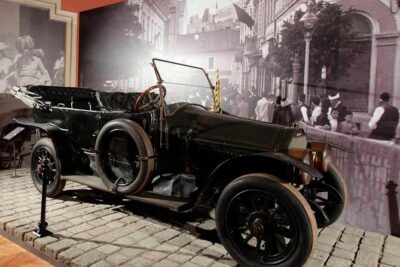
InstaSarajevo – Photography Walking Tour of Sarajevo
Read our review →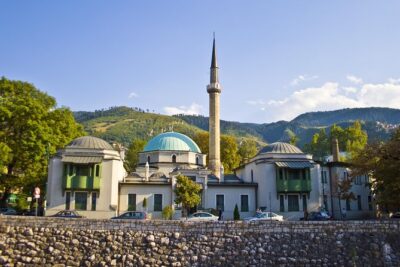
Browse the lists this tour appears in