
Reviewed · FULL-DAY
Best of Sarajevo – Ultimate Full-Day Experience
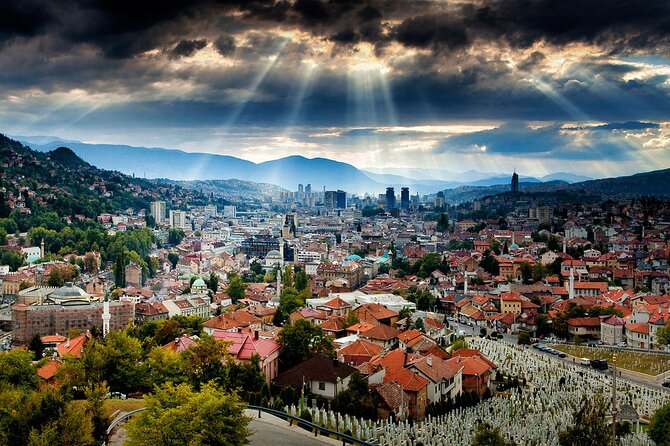
Sarajevo’s story is packed into one long day: Ottoman mosques, Catholic and Orthodox churches, Jewish heritage, Olympic memories, wartime scars, and food stops that make the past feel close at hand. This tour links those pieces with Bosnian coffee and baklava, a burek tasting, a cable-car ride, and a visit to the Tunnel of Hope.
I like the way the day combines Sarajevo’s main sights with simple local experiences, especially the old crafts on Kazandžiluk Street and the chance to walk the graffiti-covered bobsled track. I also like the small-group limit of 15 people and the fact that guide Tarik has been praised for adjusting the pace and adding requested stops.
The tradeoff is time. You cover a lot in 7 to 8 hours, so several landmarks receive only a few minutes. The final driving section may also feel less rewarding than the walking portions, especially if you prefer a slower look at the Old Town.
Key points about this Sarajevo day tour
- The day covers four faiths and several eras: Ottoman, Catholic, Orthodox, and Jewish Sarajevo all appear in the route.
- Trebević adds fresh air and views: The cable car leads to the old Olympic bobsled track, where you walk for about 30 minutes.
- Food is part of the tour: Bosnian coffee with baklava and a burek tasting are included.
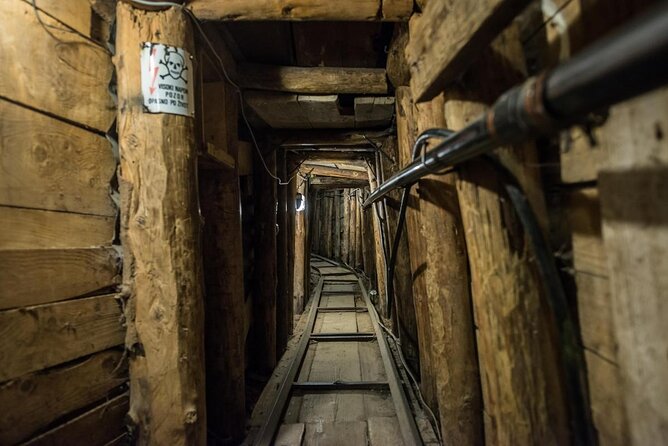
- The Tunnel of Hope gives the war story weight: You spend about an hour at Sarajevo’s wartime lifeline.
- The entry package costs extra: Cable car, Gazi Husrev-beg Mosque, Jewish Museum, Orthodox Cathedral, and Tunnel Museum admissions total 30 euros per person.
- It suits first-time visitors with limited time: You get a broad introduction without having to organize several separate visits.
Why this route gives you a clear picture of Sarajevo
This is not just an Old Town walking tour. It begins among Sarajevo’s best-known landmarks, rises into the Trebević hills, returns to the Ottoman center for food and crafts, then uses a vehicle to connect the city’s wartime sites.
That structure matters. Sarajevo can feel confusing at first because its major sights belong to different periods and communities. One street may point toward Ottoman rule, another toward Austro-Hungarian administration, and another toward the city’s Jewish, Catholic, or Orthodox population.
An English-speaking guide helps connect those parts. Guide Tarik, when assigned to your group, has been noted for keeping to the group’s pace, explaining the past impartially, and adding requested stops. The group limit of 15 should also make it easier to hear the guide than on a large coach outing.
You meet at Sarajevo Insider, Zelenih beretki 30, at 9:00 a.m. The activity returns to the same meeting point. Wear shoes suitable for walking, since the day includes the Old Town, the bobsled trail, and movement between several central sights.
A few more Sarajevo days to weigh up
- From Sarajevo: Full-Day Hike to Lukomir Village
★ 5.0 · 59 reviews - Sarajevo Full Day Tour: History, Culture, Nature, War & Olympics
★ 5.0 · 27 reviews - Sarajevo to Belgrade Full Day Tour one-way
★ 4.5 · 9 reviews
Latin Bridge begins the city’s story
The first stop is Latin Bridge, a short visit of about 15 minutes. The bridge is important because of its place in the story of the assassination of Archduke Franz Ferdinand, an event closely tied to the start of the First World War.
The stop is brief, but it gives your guide a useful opening to explain why Sarajevo has mattered far beyond Bosnia and Herzegovina. You do not need a long lecture here. The value comes from standing at the site and then seeing how close it is to the rest of the historic center.
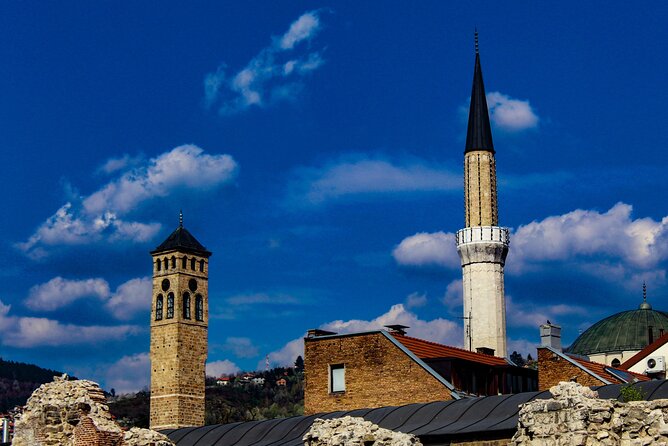
From there, the route moves through a set of compact stops. The Emperor’s Mosque is described as Sarajevo’s oldest mosque, and the guide explains the story behind the city’s name. At Jedileri, the Tomb of the Seven Brothers, you encounter a quieter site shaped by local legends and memory.
The Church of Saint Anthony of Padua adds a Catholic note to the route. A quick look at Sarajevska Pivara introduces the first brewery in the Ottoman Empire. These visits last only three to five minutes, so think of them as focused introductions rather than full tours.
Trebević Cable Car and the Olympic bobsled track
The Trebević Cable Car is the day’s change of pace. You leave the tight streets of central Sarajevo and ride toward the mountain, gaining a different view of the city along the way.
The cable-car ticket is not included in the base price. It forms part of the 30 euro entry package, which also covers several later admissions. Keep that extra cost in mind when comparing the tour with cheaper city walks.
At the top, you spend about 30 minutes at the Olympic bobsled and luge track. Sarajevo hosted the Winter Olympics in 1984, and the track remains one of the city’s most unusual reminders of that period. Today, its concrete curves are marked by graffiti, giving the walk a rough, open-air feel rather than a polished museum experience.
This section also provides physical variety. The route is not only about looking at buildings and listening to dates. You get a short mountain ride, views, and a walk along a historic sports site. If weather turns poor, this part may be affected, since the experience requires good conditions.
The Spite House and City Hall
Back in the city, the House of Spite supplies one of Sarajevo’s best small stories. The building was moved brick by brick after its original location became part of the plan for City Hall.
The story is simple and memorable: a resident refused to let the authorities take the house without a fight, so it was reconstructed across the river. You spend only about five minutes here, but it is the sort of detail that helps you notice Sarajevo’s character beyond major monuments.
Sarajevo City Hall, known locally as Vijećnica, receives another short stop. Its design reflects the Austro-Hungarian period and its place in the city’s multicultural story. Admission is not included separately in the information provided, so ask your guide how the planned entry package applies on your date.
These stops work best as part of the larger route. You are not given a long indoor visit at every building, but you do get a quick explanation of how power, architecture, and local resistance shaped the city.
A completely different kind of day out of Sarajevo:
- Sarajevo: Mostar, Konjic, Blagaj Tekke, Pocitelj & Waterfall
★ 4.9 · 1,335 reviews - Fall of Yugoslavia, Sarajevo War Tour with Tunnel of Hope Museum and Frontlines
★ 5.0 · 1,314 reviews - Sarajevo: Mostar, Konjic, Sufi House, Pocitelj & Kravice Falls
★ 5.0 · 1,179 reviews - ROSES OF SARAJEVO (Official WAR + CITY tour)- Story of a Survivor
★ 5.0 · 770 reviews
Bosnian coffee, baklava, and the crafts of Baščaršija
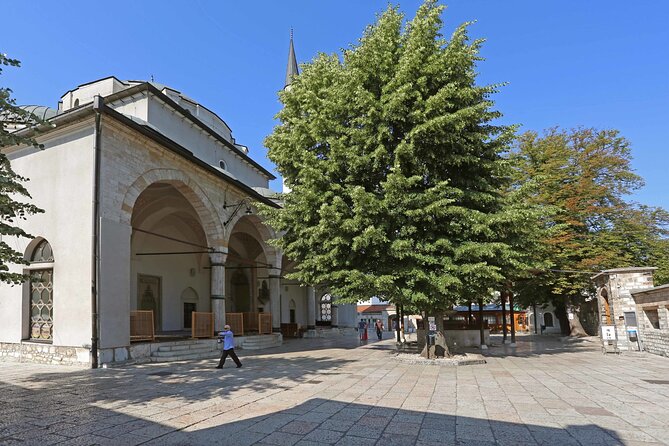
Baščaršija is where the day slows down. The 45-minute coffee break includes Bosnian coffee and baklava, so you have time to sit, taste, and ask questions rather than simply pass another monument.
Bosnian coffee is served in a small metal pot called a džezva, with the grounds left in the cup. The tasting is included, as is the baklava. This is one of the tour’s most useful features because food gives you a direct way into local custom. Take small sips and let the grounds settle before drinking too far down.
The route then reaches Kazandžiluk, the old coppersmith street. You learn about traditional crafts that still exist in Sarajevo, with copperware among the best-known examples. The stop lasts about 20 minutes, giving you more time than most of the earlier monuments.
Next comes Bravadžiluk Street and a 30-minute burek tasting. Burek is a filled pastry made with thin layers of dough, and the tasting includes an explanation of how it is prepared. Traditional food is included in the tour price, which improves the value, especially if you would otherwise pay separately for lunch.
At Sebilj Fountain, you have a one-minute stop to see the famous wooden fountain and drink its fresh water. Morica Han, a preserved Ottoman inn, follows with a short three-minute visit. These are quick pauses, but they fit naturally into a walk through the old commercial center.
Gazi Husrev-beg Mosque and the meeting of East and West
Gazi Husrev-beg Mosque is one of the most important Muslim sites in Sarajevo. The tour allows about 20 minutes to explore the courtyard and learn why the mosque remains central to local Muslim life.
Admission is not included in the basic tour price, but it is part of the 30 euro package. Dress and behavior should be respectful at any religious site. The available information does not set out a detailed dress code, so ask your guide before entering if you are unsure.
The Sarajevo Meeting of Culture is a tiny but meaningful stop. Here, you stand at the point where the city’s Ottoman eastern character meets its Austro-Hungarian western side. It takes only two minutes, yet it gives you a handy way to understand the layout of central Sarajevo.
The Jewish Museum follows with about 20 minutes. This visit focuses on Sarajevo’s Jewish community and the Sarajevo Haggadah, a major cultural object associated with the city. Admission is included in the 30 euro package.
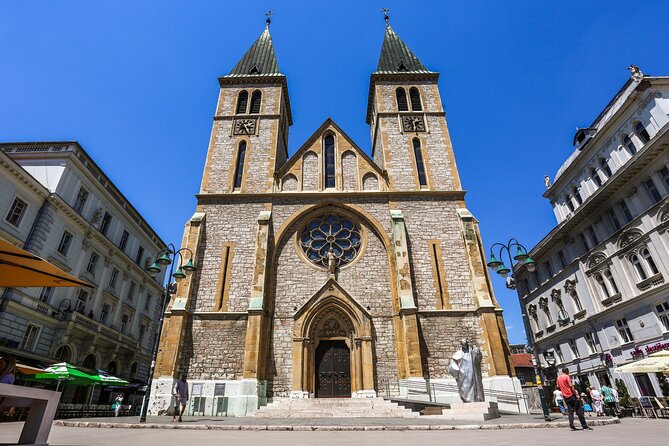
You then see the Cathedral of the Sacred Heart, a Catholic landmark, and the Serbian Orthodox Cathedral, the city’s largest Orthodox church. The Catholic Cathedral is free to visit according to the tour details, while the Orthodox Cathedral is part of the paid package.
Taken together, these religious sites are one of the tour’s strongest features. You are not seeing isolated buildings. You are being shown how several communities have shaped the same city, often within a short walk of each other.
Sniper Alley and the Tunnel of Hope
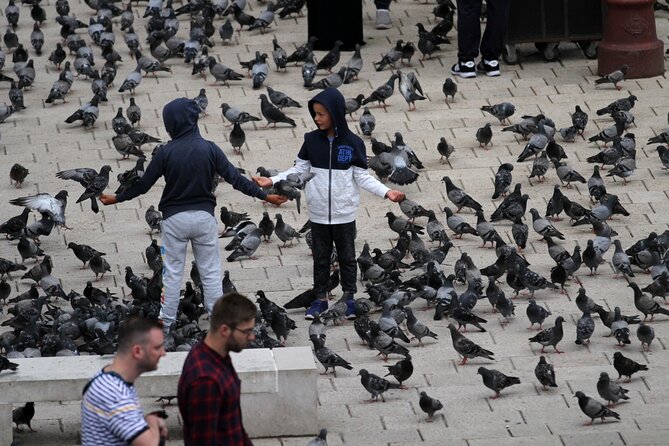
The final section shifts from Sarajevo’s older history to the Siege of Sarajevo. You drive through Sniper Alley, a street remembered as one of the most dangerous routes during the war.
This is not a normal sightseeing stop. The significance comes from the guide’s explanation and from seeing the road as part of the modern city. The driving section lasts about 30 minutes and may feel less active than the Old Town portion. One practical comment from the tour experience is that the final driving stretch was less appealing than the walking sections, so set your expectations accordingly.
The Tunnel of Hope is the day’s longest single visit, at about one hour. The tunnel served as a lifeline during the siege, connecting Sarajevo with the outside world when normal routes were blocked. At the Tunnel Museum, you learn how this narrow passage helped bring supplies and support into the city.
The museum admission is not included in the base price but is included in the 30 euro entry package. This is an important cost detail because the tunnel is one of the central reasons to choose this tour over a standard city walk.
The tunnel visit also gives the earlier stops more weight. Sarajevo’s mosques, churches, markets, and bridges are not only old monuments. They belong to a city that endured a recent war and rebuilt daily life around those memories.
Is the $84.11 price good value?
The base price is $84.11 per person. That is not the cheapest way to see Sarajevo, but it includes an English-speaking guide, air-conditioned transport, Bosnian coffee and baklava, and traditional food tasting.
You must also budget 30 euros per person for the entry package covering the cable car, Gazi Husrev-beg Mosque, Jewish Museum, Orthodox Cathedral, and Tunnel Museum. Since the cable car and Tunnel Museum are major parts of the day, I would treat that fee as a likely part of the real cost, not an optional afterthought.
The value is strongest if you want one organized day covering both the Old Town and Trebević. You also avoid arranging separate transport to the mountain and Tunnel of Hope. The value is weaker if you prefer to spend an entire morning inside museums or linger at each religious building, since many early stops are very short.
Food helps the calculation. Coffee, baklava, and burek are included, so the tour provides more than transport and commentary. For a first visit, the combination of sights and tastings gives you a useful foundation for exploring Sarajevo on your own afterward.
Who should book this experience?
I would choose this tour if you have only one or two days in Sarajevo and want an organized introduction to the city’s main themes. It suits people who enjoy history, local food, religious architecture, and a little outdoor activity in the same day.
It is also a good match if you want the Tunnel of Hope and Trebević without piecing together several separate outings. The maximum group size of 15 keeps it more personal than a large bus tour.
You may want a different format if you dislike long days, dislike vehicle transfers, or want to set your own pace. The schedule is full, and some stops are snapshots rather than extended visits. The tour also requires good weather, and the entry package adds a noticeable extra charge.
The cancellation terms are straightforward: you can receive a full refund if you cancel at least 24 hours before the 9:00 a.m. start. If bad weather or insufficient bookings cancel the activity, you are offered another date or a full refund.
Final verdict: a strong first-day choice
Book the Best of Sarajevo tour if you want the city’s major layers explained in one carefully packed day. The coffee, burek, coppersmith street, Trebević ride, Olympic track, and Tunnel of Hope keep it from becoming a simple parade of monuments.
Go in knowing that the pace is brisk and the final driving portion may not be the highlight. If you accept that tradeoff, the tour gives you a broad, useful understanding of Sarajevo for $84.11, with food and transport included and the option to cover the main admissions through one 30 euro package.
FAQ
How long does the Best of Sarajevo tour last?
The experience lasts approximately 7 to 8 hours.
What time does the tour begin?
The tour starts at 9:00 a.m.
Where does the tour start and finish?
It starts at Sarajevo Insider, Zelenih beretki 30, Sarajevo 71000, Bosnia and Herzegovina, and ends back at the same meeting point.
Is the tour offered in English?
Yes. The tour is offered in English.
What food and drinks are included?
Bosnian coffee with baklava and a traditional food tasting, including burek, are included.
Is transportation included?
Yes. An air-conditioned vehicle is included. The Trebević Cable Car is part of the paid entry package rather than the base tour price.
How much are the extra admission fees?
The entry package costs 30 euros per person. It covers the cable car, Gazi Husrev-beg Mosque, Jewish Museum, Orthodox Cathedral, and Tunnel Museum.
How large is the group?
The tour has a maximum of 15 people.
Can I cancel for a full refund?
Yes. You can cancel for a full refund at least 24 hours before the experience start time. Changes or cancellations made less than 24 hours before the start are not accepted for a refund.
Just added around Sarajevo
- Private Full Day Safari Tour★ 5.0 · 8 reviews
- Walking Tour in Sarajevo★ 5.0 · 3 reviews
- Sarajevo Under Siege: A War History Tour★ 5.0 · 10 reviews
- Mysterious Visoko Pyramids Driving and Walking Tour★ 5.0 · 7 reviews
- Secret Tito’s Bunker/Konjic Tour★ 5.0 · 4 reviews
- Travnik, Jajce, Pliva Lakes & Mills –Medieval & Ottoman Bosnia Full Day Tour★ 5.0 · 3 reviews
- The last day of Franz Ferdinand Walking Tour★ 5.0 · 10 reviews
- Sarajevo to/from Zagreb Transfer Day Tour (North-central Bosnia)★ 5.0 · 4 reviews
Full-Day, compared.
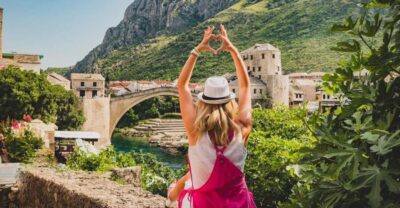
Mostar and Kravice Waterfalls Full-Day Tour from Split
Read our review →
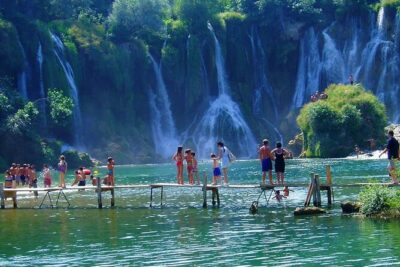
Full-Day Tour in Herzegovina, Blagaj, Počitelj, and Kravice
Read our review →
Sarajevo Full Day Tour: History, Culture, Nature, War & Olympics
Read our review →
Full Day At Kravice Waterfalls in a Day Tour from Mostar
Read our review →
Browse the lists this tour appears in